.png&w=1920&q=75)
- Date
How to Create an Online Store in Nigeria Without Spending a Fortune

Creating an online store can sound like a major investment, particularly when you start looking at everything that seems to come with it: website development, hosting, payment integration, product photography, branding, security and marketing.
For a small business in Nigeria, those costs can make selling online feel more complicated than it needs to be.
The reality is that you do not need to build an expensive ecommerce website before you can start selling online. What you need is a practical way for customers to discover your business, understand what you sell, see your prices, trust you and take the next step toward buying.
That distinction matters.
An online store is not valuable simply because it exists. It becomes valuable when it makes the buying process easier for your customers and the selling process more manageable for you.
If you are still deciding whether selling online is right for your business, start with our guide on How to Sell Products Online in Nigeria: A Practical Guide for Small Businesses.
What Is an Online Store?
An online store is a digital place where customers can discover and purchase products or services.
At its most basic level, an online store allows a business to present its offerings in an organized way. Customers can see photographs, read descriptions, review prices and learn how to place an order.
More advanced stores can include inventory management, payment processing, shipping integrations, customer accounts, discount codes, analytics and many other features.
The important thing is that you don’t need every possible feature simply because it exists.
The right starting point is to identify what your customers need to make a confident purchasing decision and what your business needs to manage those transactions effectively.
Do You Need a Custom Website?
Not necessarily.
A custom website can be the right choice for a business with very specific requirements, but it isn’t the only way to establish an online store.
A business can choose from several approaches, including building a website from scratch, using an ecommerce platform, selling through an online marketplace or using a digital storefront service.
Each option has advantages and disadvantages.
A custom website gives you considerable control, but development and ongoing maintenance can become expensive. An established ecommerce platform can reduce the technical work involved, although there may be monthly fees, transaction charges or limitations depending on the service.
Marketplaces can give businesses access to an existing audience, but sellers generally operate within the marketplace’s rules and customer experience.
A digital storefront can provide a simpler starting point for businesses that primarily need a professional online catalogue and a straightforward way for customers to discover their products.
The right choice depends on the stage of your business and what you actually need.
Start With the Customer Experience
Before choosing a platform, think about what you want a customer to experience when they find your business online.
Imagine someone discovers your fashion brand through Instagram. They are interested in one of your dresses and click the link in your profile.
What happens next?
Can they immediately see the product? Is the price clear? Are there photographs from different angles? Can they find available sizes? Is there information about delivery? Can they understand how to place an order?
These questions matter more than whether your website has an elaborate animation or dozens of technical features.
A good online store should reduce uncertainty and make the buying process straightforward.
The customer should not have to work hard to understand what you’re selling.
Choose the Products You Want to Sell Online
You don’t have to put your entire business online on the first day.
If you have a large catalogue, consider starting with your most popular products or the products that best represent your business.
A fashion business might begin with its current collection. A jewellery maker could start with its best-selling pieces. A food business might create a focused menu. A handmade business could showcase the products that consistently attract customer interest.
Starting with a manageable catalogue makes it easier to create accurate product information, maintain inventory and learn what customers respond to.
As the business grows, you can expand the catalogue.
Prepare Your Product Information
Every product you put online needs enough information for customers to understand what they are considering.
At a minimum, this will usually include:
- Product name
- Product photographs
- Description
- Price
- Available sizes, colours or variations
- Availability or inventory information
- Delivery information
- Preparation or dispatch time where applicable
Depending on the product, you may also need dimensions, weight, materials, care instructions, customization details or other specifications.
Good product information also reduces the amount of time you spend answering repetitive questions from customers.
Instead of responding individually to the same questions about size, price or availability, you can make the information available as part of the shopping experience.
Invest in Product Photography Before Fancy Website Design
When you’re working with a limited budget, the order in which you spend your money matters.
A beautifully designed website cannot compensate for poor product presentation.
Customers need to see what they’re buying, particularly when they are purchasing something they cannot physically examine before paying.
Your product photography should therefore receive attention before you start spending heavily on decorative website features.
You can often achieve strong results with a smartphone and good lighting. What matters most is that the product is clearly visible, the photographs are sharp and the presentation is consistent.
If your products have important details, show them. If the size or fit matters, provide context. If customers need to understand the colour or texture, make sure your photographs communicate those characteristics as accurately as possible.
The goal is to reduce the gap between what the customer sees online and what they receive.
Decide How Customers Will Pay
Payment is obviously an important part of an online store, but the options you need will depend on your business and your customers.
Consider how your customers currently pay you and which payment methods are practical for the type of business you operate.
Depending on your setup, you may need to consider card payments, bank transfers, mobile payment options or other locally relevant payment methods.
The important consideration is convenience and clarity.
Customers should understand how they can pay, when payment is required and what happens after payment has been completed.
Payment information should also be presented in a way that gives customers confidence that they are dealing with a legitimate business.
Think About Delivery Before You Launch
An online sale isn’t complete when someone clicks a payment button.
You still have to get the product to the customer.
For a physical-product business, delivery can therefore have a significant impact on the customer experience and the economics of the sale.
Before launching your store, think through the areas you can reasonably serve, how products will be packaged, how delivery costs will be calculated and how customers will receive tracking or other delivery information where applicable.
Your delivery policy doesn’t need to be complicated.
It does need to be understandable.
Customers should have a reasonable idea of when they will receive their order and what they should expect after making a purchase.
Don’t Forget About Trust
An online store is also an opportunity to demonstrate that your business is legitimate.
Customers who have never purchased from you before will look for signals that they can trust you.
Your business name, contact information, product photographs and descriptions all contribute to that impression. Customer reviews, testimonials and information about your business can provide additional reassurance.
Policies matter as well.
If there are conditions around returns, exchanges, cancellations or customized products, explain them clearly.
Trust doesn’t come from making a website look expensive. It comes from giving customers accurate information and consistently delivering on what you promise.
Make Your Store Mobile-Friendly
A significant portion of your customers will probably discover your business through a smartphone.
Someone might see your product on WhatsApp, Instagram or TikTok and click through to your store immediately.
The experience needs to work well on that small screen.
Customers should be able to navigate your products without difficulty, read the text, view photographs, understand prices and take the next step without unnecessary friction.
A mobile-friendly store is not an optional extra for a business that wants to sell online. It is part of the basic customer experience.
How Much Should You Spend on Your Online Store?
There isn’t one price that applies to every business.
The cost can range from relatively little for a simple storefront or platform subscription to considerably more for a fully customized ecommerce website.
Your total cost may involve several components:
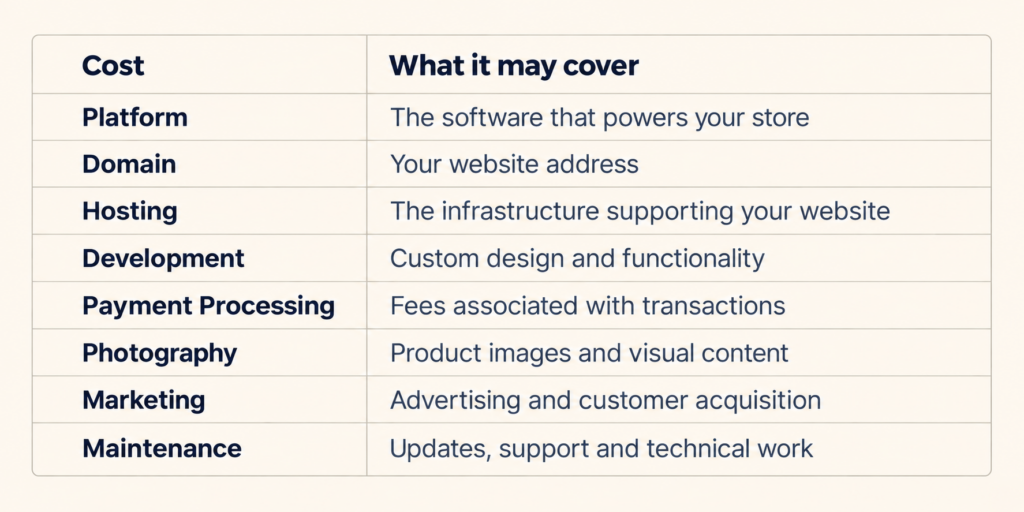
The mistake is to look only at the initial cost of building the website.
A store can be inexpensive to launch but expensive to operate, or it can cost more initially while providing functionality that saves money elsewhere.
What matters is the total cost relative to the value the store provides to your business.
For a small business, that means being particularly careful about paying for features you don’t currently need.
Where Small Businesses Often Overspend
When entrepreneurs think about building an online store, it is easy to focus on how the store looks rather than what it needs to accomplish.
A sophisticated design may be attractive, but it doesn’t necessarily generate more sales.
Similarly, a business may pay for advanced functionality that it rarely uses while overlooking fundamentals such as product photography, pricing, customer service and fulfilment.
Your budget should reflect the stage of your business.
If you are still testing your products and building your customer base, keeping your technology costs manageable can give you more flexibility to invest in the areas that directly contribute to growth.
As your business becomes more established, you can make larger investments based on actual customer behaviour and business requirements.

Your Online Store Should Work With Your Social Media
Creating an online store doesn’t mean abandoning the channels you’ve already built.
For many Nigerian businesses, WhatsApp, Instagram, Facebook and TikTok will continue to be important sources of awareness and customer engagement.
The store can become the place where those channels lead.
A customer might discover your product through a TikTok video, visit your Instagram profile and then use your store link to browse your products.
Another customer might see something on WhatsApp Status and click through to your catalogue rather than asking you to send individual photographs.
This creates a more connected customer journey.
Social media helps people discover you. Your online store gives them a structured place to learn more about what you sell.
What Should a Small Business Look for in an Online Store Platform?
If you’re comparing options, focus on the things that matter to your business rather than simply choosing the platform with the longest feature list.
Consider whether the platform provides:
- An easy way to add and manage products
- Professional product pages
- Mobile-friendly storefronts
- Payment options suitable for your customers
- Support for your delivery process
- A simple way to share your store link
- Inventory management appropriate for your business
- Customer and order management
- Reasonable transaction or subscription costs
- Support when you need help
You should also understand the terms before committing.
Look at monthly fees, transaction fees, payment processing costs, limits on products or orders and any additional charges that may apply as your business grows.
The cheapest platform on paper isn’t necessarily the least expensive option once all of its costs are considered.
What About AFOMA Marketplace?
This is the problem AFOMA is trying to solve.
We believe Nigerian small businesses should have access to a professional digital storefront without having to make a large technology investment before they have even established their online sales.
AFOMA is preparing to launch in Nigeria with an affordable storefront model designed for small businesses. The planned starting price is ₦1,000 per month.
The idea is to make the entry point simple enough for a growing business to establish its digital presence while continuing to use the channels it already relies on.
A fashion designer can continue using Instagram to showcase new designs. A baker can continue using WhatsApp to communicate with customers. A beauty professional can continue using social media to demonstrate their work. Their AFOMA storefront can provide a dedicated place where customers can find their business and browse what they offer.
The technology should support the business rather than become another expensive project for the owner to manage.
If you are interested in the Nigeria launch, join the AFOMA Marketplace waitlist to receive updates as registration opens.
What You Actually Need to Get Started
Creating an online store doesn’t require you to have every piece of your digital business figured out beforehand.
You need a product or service that you can deliver reliably, a clear understanding of your customer, accurate pricing and good product information. From there, an online storefront can give customers a place to discover your business and understand how to buy from you.
The rest can develop over time.
Your catalogue can grow as demand becomes clearer. Your photography can improve as you invest in better content. Your marketing can become more sophisticated as you understand which channels generate customers. Your technology can evolve when your business actually needs additional functionality.
This approach is particularly useful for small businesses because it keeps the cost of getting started proportionate to the stage of the business.
You Don’t Need a Fortune. You Need the Right Foundation
The purpose of an online store is not to make your business look bigger than it is. It is to make it easier for customers to discover your business, understand what you offer and take the next step.
For a small business, that foundation can be relatively simple.
You need good products or services, accurate information, professional presentation, a reliable way to receive payments and fulfil orders, and an online destination that customers can access easily from their phones.
As the business grows, the store can grow with it.
That is a more sustainable approach than spending heavily at the beginning in the hope that an expensive website will create a successful business on its own.
Ready to Create Your Online Store?
If you’re a Nigerian small business owner and you’ve been putting off creating an online store because you assumed it would be too expensive or complicated, AFOMA is being built with businesses like yours in mind.
Our planned Nigeria launch will offer digital storefronts starting at N1,000 per month, giving small businesses an affordable way to establish a professional online presence.
If you’d like to be among the first businesses to hear about the launch and early access, join the AFOMA Nigeria waitlist.
Join the AFOMA Nigeria Launch Waitlist
Frequently Asked Questions
How much does it cost to create an online store in Nigeria?
The cost depends on the platform, design, functionality and services you choose. A simple storefront can cost considerably less than a fully customized ecommerce website, while ongoing expenses may include platform fees, hosting, payment processing and maintenance.
Can I create an online store without hiring a developer?
Yes. Many ecommerce platforms and digital storefront services are designed so that business owners can create and manage their stores without extensive technical knowledge.
What do I need to create an online store?
At a minimum, you will generally need your business information, products or services, prices, photographs, descriptions and a way to manage payments and fulfilment. The exact requirements depend on the platform you choose.
Can I sell through WhatsApp and have an online store?
Yes. WhatsApp and an online store can complement one another. WhatsApp can remain a useful channel for communication while your storefront provides a structured place for customers to browse your products.
Do I need a physical shop before creating an online store?
No. A business can operate from a home, studio, workshop or other location and still establish an online storefront. The important consideration is whether you can reliably deliver the products or services you sell.
What should I look for when choosing an e-commerce platform?
Consider the platform’s cost, ease of use, payment options, mobile experience, product and order management, fulfilment capabilities, customer support and any limits or additional fees that may apply as your business grows.
How much will an AFOMA storefront cost in Nigeria?
AFOMA is preparing to launch digital storefronts in Nigeria starting at N1,000 per month. Businesses interested in receiving launch information can join the waitlist.
Related Reading
How to Sell Products Online in Nigeria: A Practical Guide for Small Businesses
